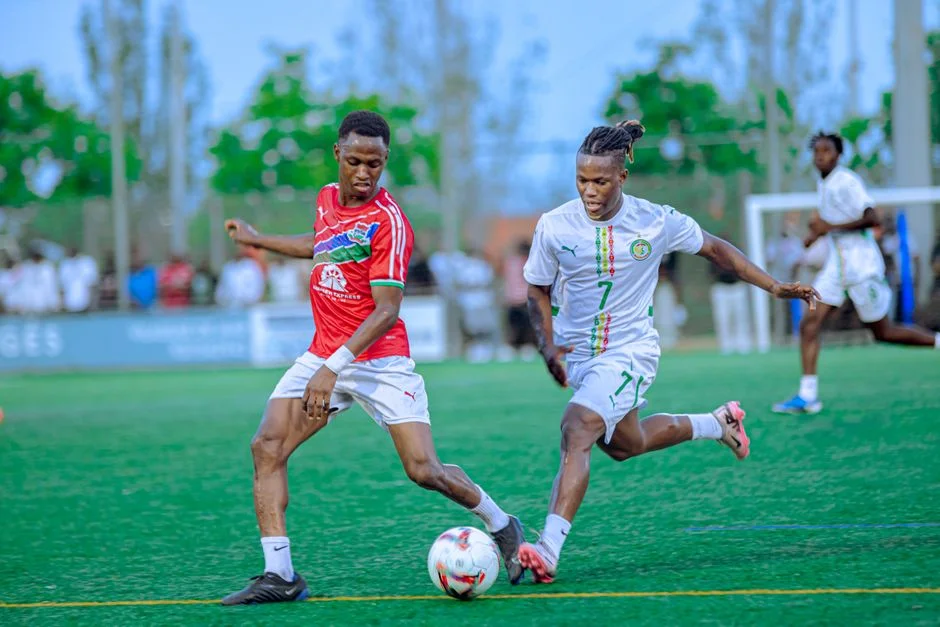
Football, it is often said, has a way of connecting people and places that politics and geography conspire to keep apart. The relationship between Nigerian football and Ukrainian football is a fine illustration of this principle. On the surface, the two footballing cultures could not be more different — one rooted in the sun-baked pitches of West Africa, incubated in the passion of Lagos street football and the intensity of Nigerian domestic rivalries; the other forged in the industrial cities of Eastern Europe, shaped by Soviet sporting traditions and the fierce local pride of Ukrainian clubs. Yet beneath these differences lies a genuine and evolving connection that has brought Nigerian talent to Ukrainian stadiums and Ukrainian expertise to Nigerian training grounds.
For regular coverage of Ukrainian football and sports news that includes this international dimension, Sport.d.ua provides comprehensive reporting on the Ukrainian Premier League and beyond.
Nigerian Players in the Ukrainian Premier League
The Ukrainian Premier League has been a destination for African talent for more than two decades. The league's clubs — Dynamo Kyiv, Shakhtar Donetsk, Metalist Kharkiv, Dnipro Dnipropetrovsk, and others — have scouted and signed African players both as a source of genuine quality and as a cost-effective way to strengthen their squads relative to the prices demanded for equivalent European talent.
Nigerian players have been among the most prominent African presences in Ukrainian football. Over the years, a steady stream of Nigerians have passed through the league, with varying degrees of success, but collectively contributing to a Nigerian imprint on Ukrainian football culture that is impossible to ignore.
Notable Nigerian Players in Ukrainian Football
- Julius Aghahowa — The Shakhtar Donetsk striker became one of the most celebrated African players in Ukrainian football history. His partnership with other African teammates at Shakhtar in the early 2000s helped transform the club from a domestic contender into a genuine European force. His acrobatic backflip goal celebrations became iconic in Donetsk.
- Obafemi Martins — Although more famously associated with European clubs in Germany and England, Martins had connections to the scouting networks that fed African talent into Eastern European football.
- John Obi Mikel — Before his celebrated career at Chelsea, Mikel's trajectory through European football illustrated the pathways that took Nigerian talent across the continent, with Eastern European clubs often serving as stepping stones or alternative destinations.
- Multiple Nigerian players featured for Shakhtar Donetsk's reserve teams and feeder clubs, with the club's Brazilian-dominated first team coexisting with African talent in the wider squad structure.
Shakhtar Donetsk: The African Connection
Shakhtar Donetsk deserves particular examination in any account of the African-Ukrainian football relationship. The club, owned by oligarch Rinat Akhmetov and bankrolled by the wealth of the Donbas industrial region, pursued an ambitious internationalisation strategy from the early 2000s that involved signing large numbers of Brazilian players alongside talent from across Africa.
This strategy transformed Shakhtar from a Ukrainian domestic club into a recognisable European brand. The club won the UEFA Cup (now Europa League) in 2009, defeating Werder Bremen in Istanbul in one of the most dramatic finals in the competition's history. The squad that achieved that feat contained multiple Brazilian stars, but the African players who had passed through the club in earlier years had contributed to building the culture and the infrastructure that made such success possible.
Ukrainian Coaches in Nigerian Football
The traffic in football expertise between Ukraine and Nigeria has not been one-directional. Ukrainian coaches — products of the Soviet and post-Soviet coaching schools that produced some of the most tactically sophisticated football minds in Europe — have found their way to Nigeria and to broader African football.
The Soviet coaching tradition, which emphasised deep tactical preparation, intensive fitness work, and collective discipline, produced coaches who were in demand globally from the 1990s onward. Ukrainian coaches who emerged from this tradition brought a systematic approach that contrasted with and sometimes complemented the more instinctive, individually driven styles associated with West African football.
The Philosophy Gap and What Both Sides Learned
When Ukrainian coaches worked in Nigerian or African football contexts, the encounter was often productive precisely because of the tensions and differences it surfaced. Nigerian football, at its best, is characterised by extraordinary individual athleticism, creative spontaneity, and an attacking instinct that can overwhelm opposition through sheer dynamism. Ukrainian coaching traditions emphasised defensive organisation, positional discipline, and collective shape.
Coaches who navigated this difference successfully found ways to harness Nigerian athleticism within tactical frameworks that made the team harder to break down and more consistent in their output. The synthesis — explosive, tactically aware football that combined African physicality with European organisation — is the model that the best modern African national teams have pursued, and Ukrainian coaches were among those who contributed to that evolution.
Victor Osimhen: A Path That Tells a Story
No discussion of Nigerian football and its European connections can avoid Victor Osimhen, who emerged from the streets of Lagos to become one of the most expensive and celebrated strikers in the world. While Osimhen's path through European football took him primarily through Germany (VfL Wolfsburg), Belgium (RSC Charleroi), France (LOSC Lille), and Italy (SSC Napoli and Galatasaray), his trajectory illustrates the mechanics of how Nigerian talent navigates European football.
Osimhen grew up in Lagos in circumstances of genuine poverty, and his football talent was identified through the informal scouting networks that connect Nigerian grassroots football to European clubs. His extraordinary physical attributes — pace, strength, aerial ability — combined with a goalscoring instinct that borders on the supernatural, made him attractive to clubs across Europe.
The Eastern European Alternative Path
For every Osimhen who finds a direct path to major European leagues, there are dozens of Nigerian players for whom Eastern European football — including the Ukrainian Premier League — represents either a stepping stone or a destination. The Ukrainian league's UEFA coefficient, while lower than the top five European leagues, is high enough that experience there is valued by clubs looking to step up.
Several Nigerians have used Ukrainian clubs precisely as stepping stones. A player who performs well at Dynamo Kyiv or Shakhtar Donetsk's broader squad structure, or at clubs like Vorskla Poltava or Olimpik Donetsk, can attract attention from agents and scouts with connections to larger European markets. Ukraine, in this sense, functions as part of the extended network through which Nigerian talent finds its way to the highest levels of European football.
- The Ukrainian Premier League operates at a level competitive enough to develop serious professional talent
- Lower wages relative to western European leagues make Ukrainian clubs accessible for Nigerian talent at earlier career stages
- Shakhtar Donetsk's European competition experience provides exposure to continental football not available in some smaller leagues
- Ukrainian clubs have well-established scouting networks in West Africa
- The proximity to western Europe makes career transitions from Ukrainian clubs relatively straightforward
Boxing: Usyk, Nigerian Fighters and the African Connection
Ukrainian boxing has a distinguished international history, and its connections to African boxing — including Nigerian boxing — form an intriguing parallel narrative to the football story.
Oleksandr Usyk is the most celebrated Ukrainian boxer in history. His achievement of becoming unified heavyweight champion of the world, defeating Anthony Joshua twice and Tyson Fury, places him in the company of the all-time greats. Usyk's path from undisputed cruiserweight champion to heavyweight history-maker has been one of the defining sports stories of the 2020s.
Nigerian Boxing and Ukrainian Champions
Nigerian boxing has produced some of the continent's most significant fighters over the decades. The Nigeria Boxing Board of Control has governed a sport with deep grassroots roots and a passionate following, particularly in cities like Lagos and Warri where boxing gyms have shaped generations of athletes.
The broader Africa-Ukraine boxing connection is less direct than the football relationship but is nonetheless real. When Usyk and other Ukrainian champions competed in international bouts, African challengers were among their opponents. The WBC, WBA, and IBF sanctioning bodies that oversee professional boxing all have significant African membership, and Nigerian representatives have been active in shaping the governance of the sport at international level.
Youth amateur boxing exchanges between African and Eastern European federations have historically provided developmental opportunities for fighters on both sides. The Soviet amateur boxing tradition, which Ukraine inherited, was among the most sophisticated in the world, and its training methodologies influenced boxing development globally — including in Africa, through coaches and programs that circulated widely in the post-Cold War era.
How Ukrainian Sports Media Covers Nigerian Football
Ukrainian sports journalism, which has a long tradition of serious football analysis and reporting, has given increasing attention to Nigerian and African football in recent years. The reasons are partly commercial — the growth of African leagues as betting markets, the international transfer market for African players, and the genuine quality of African football at international level — and partly journalistic, reflecting the broader international curiosity that the Africa Cup of Nations and World Cup generate.
Sport.d.ua and other Ukrainian sports outlets have covered Super Eagles campaigns at AFCON and World Cup tournaments, providing Ukrainian audiences with analysis of Nigerian tactical setups, star player profiles, and match reports that treat African football with the seriousness it deserves. This coverage has contributed to a Ukrainian public that is more aware of and interested in Nigerian football than might otherwise be expected.
Super Eagles Coverage in Ukrainian Media
The Super Eagles — Nigeria's senior national football team — have been among the most consistently successful African sides at international level. Three AFCON titles, multiple World Cup appearances, and a roster that at various times has included some of the most recognisable names in world football have given Nigeria a profile in global football consciousness that Ukrainian journalists cover with genuine interest.
Players like Jay-Jay Okocha, Nwankwo Kanu, Rashidi Yekini, and more recently Victor Osimhen, Wilfried Ndidi, and Alex Iwobi have been known figures in Ukrainian football circles. Their club careers in major European leagues meant that Ukrainian journalists writing about European football regularly encountered and reported on their performances.
AFCON and Euro: Parallel Qualification Campaigns
One of the more intellectually interesting parallels in the Nigeria-Ukraine football story is the similarity in the structure and drama of their respective continental qualification campaigns. Nigeria navigates the Africa Cup of Nations qualification process — a gruelling series of home and away matches across African geography, with all the logistical challenges, political pressures, and passionate partisanship that implies. Ukraine navigates UEFA European Championship qualification — equally competitive, equally pressured, in a different but equally complex environment.
Both national teams have experienced the full range of qualification emotions: the euphoric qualification campaigns, the ignominious failures to qualify, the controversial refereeing decisions, the injury crises and player availability disputes, the managerial controversies. The structural parallels in the challenges facing both football associations are real, even if the specific contexts are very different.
- Both Nigeria and Ukraine have experienced significant managerial instability in their national team setups
- Both struggle with the tension between foreign and domestic coaching philosophies
- Both face challenges in convincing diaspora-eligible players to commit to the national team
- Both have complex relationships with their domestic leagues and club football establishments
- Both have passionate supporter cultures that can be as demanding as they are energising
Youth Academies and the Dynamo Kyiv Model
Dynamo Kyiv, one of the most historically significant clubs in European football, has a youth academy that is regarded as one of the best in Eastern Europe. The Dynamo academy system produced generations of Ukrainian internationals and, during the Soviet era, players who represented the USSR at the highest level.
In the modern era, Dynamo has expanded its scouting reach globally, including into Africa. The club's interest in young African talent reflects both the quality available on the continent and the cost advantages of signing young African players relative to equivalent European prospects. While Dynamo's African recruitment has been more modest than Shakhtar's extensive Brazilian operation, the club has maintained active scouting relationships with African football intermediaries.
Nigerian Players Scouted by Ukrainian Clubs
The scouting of Nigerian players by Ukrainian clubs typically operates through a network of agents and intermediaries who have established relationships on both sides. In Nigeria, local agents with knowledge of the academy landscape and the domestic league identify promising players. European-based agents or representatives with Ukrainian club connections then facilitate trials and, if successful, transfers.
This system is imperfect — it can be exploitative of young players who lack leverage and information — but it has also provided genuine opportunities for Nigerian talent that might not have found paths to European professional football through other means. The players who succeed in Ukrainian football often use it as a platform for moves to larger leagues, while those who do not succeed at least gain professional experience and financial stability.
FIFA Rankings and the Competitive Comparison
Nigeria and Ukraine occupy broadly comparable positions in FIFA's world football rankings, with both nations consistently ranking in the top 30 to 50 globally. This reflects the genuine quality of both footballing cultures while also indicating the gap that separates them from the elite tier of world football.
For Ukraine, the ranking is a product of a strong domestic league, effective youth development through clubs like Dynamo and Shakhtar, and a national team that has consistently competed in European Championship and World Cup qualification. For Nigeria, it reflects the extraordinary raw talent produced by the country's football culture, the success of the Super Eagles in African competition, and the growing number of Nigerians playing at the highest levels of European club football.
The FIFA ranking comparison also provides a useful framework for imagining what a competitive match between the two national teams would look like — an entertaining, closely contested encounter that would test different football philosophies against each other. Officially, Nigeria and Ukraine have met rarely in international football, making any such encounter a relative novelty that supporters on both sides would anticipate with genuine excitement.
Future Potential: What Collaboration Could Look Like
The football relationship between Nigeria and Ukraine has developed organically, driven by market forces, talent flows, and individual decisions rather than any systematic bilateral framework. Looking ahead, there is potential for a more structured engagement that could benefit both footballing cultures.
Youth Development Cooperation
A formal cooperation agreement between the Nigeria Football Federation and the Ukrainian Association of Football on youth development could provide Nigerian academies with access to Ukrainian coaching methodologies, sports science expertise, and tactical training frameworks. In the other direction, Ukrainian youth teams could benefit from exposure to the physical and technical qualities that West African youth football develops at its best.
Coach Exchange Programs
A structured program for exchange of coaching expertise — Ukrainian coaches working in Nigerian academies and at state football associations, Nigerian coaches receiving training at Ukrainian football institutions — could be a practical and low-cost intervention that yields long-term dividends for both parties.
- Joint coaching certification programs could be developed under CAF and UEFA frameworks
- Summer youth football camps bringing together Nigerian and Ukrainian young players could build personal connections
- Friendly internationals at youth and senior level could provide competitive experience and deepen the relationship
- Data sharing on player development methodologies could benefit both associations' technical departments
- Scholarship programs for Nigerian coaches to study at Ukrainian football institutes could transfer expertise sustainably
Conclusion: Football as Diplomacy
The beautiful game has always been more than sport. It is a language spoken across cultural and political barriers, a space where competition and respect can coexist, and a medium through which people discover unexpected common ground. The football relationship between Nigeria and Ukraine — still modest in scope but genuine in character — is an example of this principle in action.
In the years ahead, as Ukraine navigates its way through and eventually beyond the current war, football will be part of the country's restoration of normal life and international connection. For Nigeria, a country always hungry for international engagement that reflects its status as Africa's most populous nation and largest economy, the Ukrainian football connection offers a small but real avenue for the kind of relationship-building that accumulates into genuine partnership.
The Super Eagles and whatever symbol will one day represent Ukraine's national team have not often faced each other across a football pitch. When they do, it will be a contest between two nations with more shared history, more mutual respect, and more reasons to engage seriously with each other than most observers would guess. That, ultimately, is what the beautiful game does best.
See Also
- Pezeshkian Urges Putin for Support Against Aggression: What It Means for Africa
- MS Dhoni's IPL Showdown: How It Could Impact Nigerian Fans